
- Blog
- Role of AI Agents in Modern Organization: From Automation to Empathy
- AI Articles ,
- December 31, 2025
 Iffort
 Every organization, regardless of the industry, faces the same invisible challenge.
Sales teams spend hours qualifying leads that may never convert.
Clinic staff juggle appointment calls instead of focusing on patient care.
Families worry about elderly parents living alone.
Schools and parents struggle to identify early signs of mental health challenges in children.
These are not problems of intent or effort.
They are problems of time, scale, and repetition.
Now imagine intelligent digital agents working quietly in the background – handling conversations, scheduling tasks, tracking context, and escalating only when human judgment is truly required.
This is not the future.
This is already happening.
AI Agents are autonomous, goal-oriented, and context-aware systems designed to perform tasks, interact conversationally, and make decisions within defined boundaries.
Unlike traditional chatbots or rule-based automation, AI agents:
Modern organizations are overwhelmed by repetition. Whether it’s a support agent answering the same query hundreds of times or an operations executive updating spreadsheets nightly, the result is the same – wasted hours and lost focus.
AI agents address these pain points through:
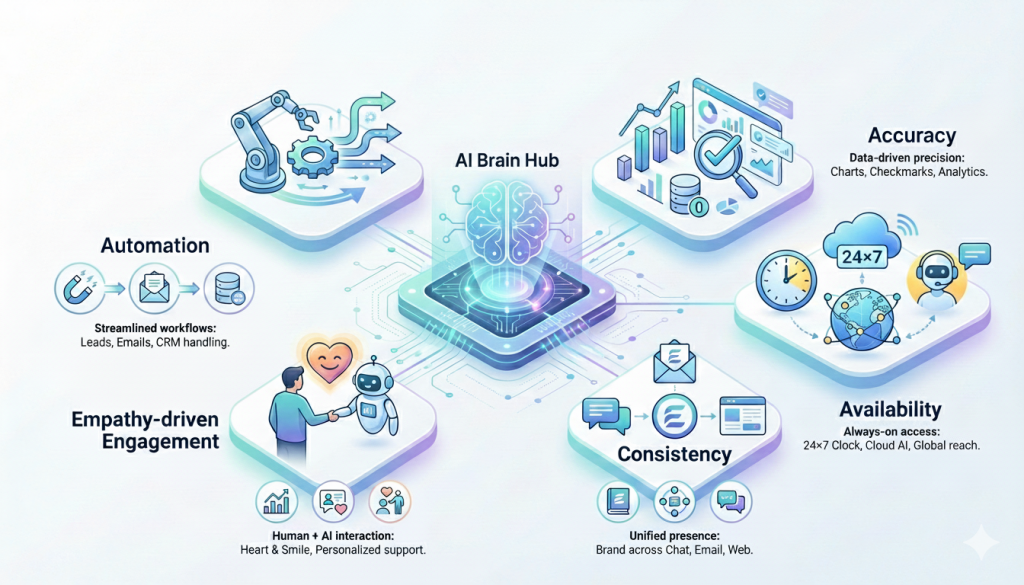
At Iffort, we are witnessing how AI Agents are transforming organizations – not just by automating workflows, but by adding empathy, responsiveness, and intelligence to everyday operations.
Industry: Real Estate
The Problem:
Real estate sales teams spend countless hours on initial qualification calls, while customers struggle to find properties matching their true preferences.
The Role of the Agent:
Mirai AI understands buyer or renter preferences from conversations, recommends matching properties, schedules site visits, and even sends follow-up reminders.
The Enterprise Value:
Mirai AI doesn’t just automate a conversation – it redefines how sales cycles can be intelligently accelerated.
Industry: Health Care
The Problem:
Front-desk staff in clinics spend hours manually confirming appointments, checking doctor availability, and managing cancellations – a process ripe for human error.
The Role of the Agent:
Our conversational AI bot on WhatsApp handles appointment scheduling end-to-end. It checks real-time doctor availability, confirms slots, and shares reminders – all through a familiar messaging interface.
The Enterprise Value:
By integrating with existing clinical management systems, the WhatsApp AI bot transforms healthcare scheduling into a smooth, human-like conversation.
Industry: Mental Health & Education
The Problem:
Early detection and consistent care for children’s mental health is complex. Families and schools often lack continuous, accessible support.
Role of the AI Agent:
This conversational AI agent:
Human Impact:
Here, AI is not replacing care – it is extending care.
The Problem:
With families often living apart, checking on elderly loved ones daily becomes emotionally taxing and logistically difficult.
The Role of the Agent:
The old-age care AI agent initiates daily conversations with elderly users, assesses their mood and health indicators from speech patterns, and summarizes findings for family members. It can raise alerts in case of unusual emotional or physical cues.
The Human Value:
“The future of organizations is not AI replacing humans, but AI working quietly in the background so humans can do what they do best.”
At Iffort, our mission goes beyond building AI tools – we craft intelligent, ethical, and industry-ready agents that integrate seamlessly into business workflows.
As the use of machine learning and artificial intelligence (AI) technologies continues to grow, so do the ethical concerns surrounding their development and implementation. The Open AI CEO, Sam Altman recently admitted that the technology behind ChatGPT, an AI chatbot is potent and potentially hazardous. There are rising examples of AI systems producing biased or […]
The whole world is talking about ChatGPT and other conversational machine-learning tools. GPT-1, GPT-2, GPT-3, and GPT-4 are all members of the same family of AI models known as transformers. This means that they are trained to solve more collective tasks than the previous generation of machine learning models, also known as meta-learning, eliminating the […]

The financial landscape is continually evolving, and as a result, the challenges associated with risk management and fraud detection are becoming increasingly complex. Risk Management and Fraud Detection are two essential components of any successful business strategy. However, companies must navigate numerous challenges to effectively manage these areas, while fraudsters continue to develop new techniques […]
This blog is an excerpt from a presentation delivered recently by Daksh Sharma, the co-founder of Iffort, at the 7th edition of #SMLive, Social Samosa’s virtual conference. To know more, click here. For more than a decade, I have witnessed the remarkable influence of Artificial Intelligence (AI) across various industries, including marketing. Leveraging AI in […]
If there’s one term that has exploded in search engines in 2023, it is Artificial Intelligence (AI). With the arrival of ChatGPT, everyone is trying to understand what it implies for them and what the future holds. No doubt that it’s a common buzzword today, but the concept of AI has existed for a long […]
With technology playing an increasingly central role in business operations, the adoption of Artificial Intelligence (AI) is becoming more prevalent. AI has the potential to revolutionise how businesses operate, and Generative AI is one of the key technologies that businesses can leverage to unlock their potential. According to Acumen research and consulting report, The Global […]
As technology continues to revolutionise every aspect of our lives, it’s no surprise that education is also undergoing a major transformation. Personalised learning and curriculum development have emerged as key areas of focus for educators looking to improve student outcomes and prepare students for the future. Personalised learning has been a buzzword in education for […]
Architecture and urban planning are essential components of our built environment, shaping the spaces in which we live, work, and play. These fields have a rich history, with roots in ancient civilizations and evolving through various design styles and approaches. As our societies grow and urbanization continues, the need for sustainable and innovative solutions in […]
Are you ready to enter the realm of AI-powered conversation marketing, where the dance of engagement & connection unfolds between businesses and their customers? The choreography is complex, the rhythm enthralling, and the possibilities appear infinite. But as with any tango, there are challenges to navigate and missteps to evade. Let us waltz through the […]

Since the launch of ChatGPT in November 2022, there has been an increased interest in generative AI. The idea that millions of jobs will be lost due to ChatGPT has naturally scared a majority but on the other hand, many businesses, sensing the promise ahead have even formed teams trying to understand how they can improve efficiency using generative […]
The healthcare industry is on the verge of a major change powered by Generative Artificial Intelligence (AI). This shift could transform the way we approach medicine, making it more personal, efficient, and accessible. In this article, we will explore the impact of AI on medical diagnostics, treatment planning, and patient care. Additionally, we’ll delve into […]

“Caution” is perhaps the best way to describe how the healthcare industry is perceiving Generative AI right now. The cautious approach about Generative AI isn’t surprising as the tech is still evolving to have more serious and direct benefits such as diagnosing patients or directly providing medical care. With hallucinating responses, there is obvious risk […]

Advertising is crucial to the game of e-commerce because it serves as a beacon for people to find and interact with your goods and services. Because of the strong rivalry and exponential growth of the digital industry, there is a growing need for creative marketing techniques. Here, the ground-breaking development of generative artificial intelligence (AI) […]

In the dynamic landscape of customer experience, AI voice agents are poised to revolutionize interactions between businesses and their customers. These intelligent systems, powered by generative AI, promise to enhance efficiency, personalization, and overall satisfaction. While the promise of AI voice agents is immense, challenges remain, including accuracy, bias, privacy, and human oversight. Responsible implementation […]

What is RAG RAG, or Retrieval-Augmented Generation, is a powerful artificial intelligence (AI) technique that is transforming the way we approach complex problem-solving. This innovative approach combines the strengths of reinforcement learning and generative models, allowing AI systems to tackle a wide range of challenges with unprecedented efficiency and accuracy. At its core, RAG leverages […]

The travel industry has seen huge changes thanks to new tech. One big change is how artificial intelligence, or AI, has moved beyond basic chatbots. Today, AI can create more engaging, customized travel experiences. With the future of conversational AI moving forward fast, travelers can look forward to smoother and more personalized trips. Let’s dive […]

In today’s changing environment, worldwide industries are incorporating advanced technologies to boost their efficiencies and significantly enhance customer satisfaction levels. In the travel industry, digital twin technology has emerged as a game changer. This innovation, combined with Artificial Intelligence (AI), is reshaping customer interactions and streamlining operations, redefining how issues are addressed and services are […]
Introduction Communication with customers and other stakeholders is key in the current world of automation and is, therefore, vital. Retell AI’s Batch Call feature is a great tool for managing numerous calls at once, which is useful for campaigns, updates, and time-specific messages. This blog is a technical deep dive into how to use Retell AI’s Batch […]
Introduction When it comes to Generative AI, knowledge management has also come to the forefront as an important factor for businesses that aim to outperform their rivals. With the advanced functionalities of Retell AI, it is now easier and more convenient to develop a flexible and intelligent knowledge base. The following blog is a technical […]
Effective call handling is a very important factor that helps to maintain clear and effective communication as well as provide the best customer service. Retell AI’s Transfer Call feature is therefore designed to help users easily move calls between agents whether artificial or human and in the process optimize on time and improve user experience. […]
Introduction In the rapidly evolving world of Voice AI, where innovation meets real-world impact, iffort.ai is a certified partner of Retell AI (Retell AI Partner Program). We specialize in transforming how businesses leverage voice intelligence, collaborating with pioneers like Retell AI to deliver tailored solutions that redefine efficiency, accuracy, and scalability. This case study is […]
When Everyday Tasks Become Everyday Bottlenecks Every organization, regardless of the industry, faces the same invisible challenge. Sales teams spend hours qualifying leads that may never convert.Clinic staff juggle appointment calls instead of focusing on patient care.Families worry about elderly parents living alone.Schools and parents struggle to identify early signs of mental health challenges in […]